GCC Blog · Issue #2 · The Hotspot Report
June 1, 2026
Reading the map
Last month we told you why we exist. This month we go a layer deeper into the evidence — what 110+ resident-mapped hotspots actually reveal, the blocks we can already name, and the neighbor who equipped our first crews.
§1 · Where we left off
In Issue #1, we laid out the thesis: Global Community Cleaners isn’t a cleaning service — it’s the field-evidence layer for community cleanliness in North Lawndale, six blocks from the apartment Dr. King moved into in 1966. We pay the resident on the block to clean it, and we document every inch of it.
One month on, the map has kept growing. So this issue is about the part most organizations skip: actually reading the data — and being honest about what it does and doesn’t yet tell us.
You can’t fix a block you haven’t looked at honestly. So we looked.
§2 · The map, one month on
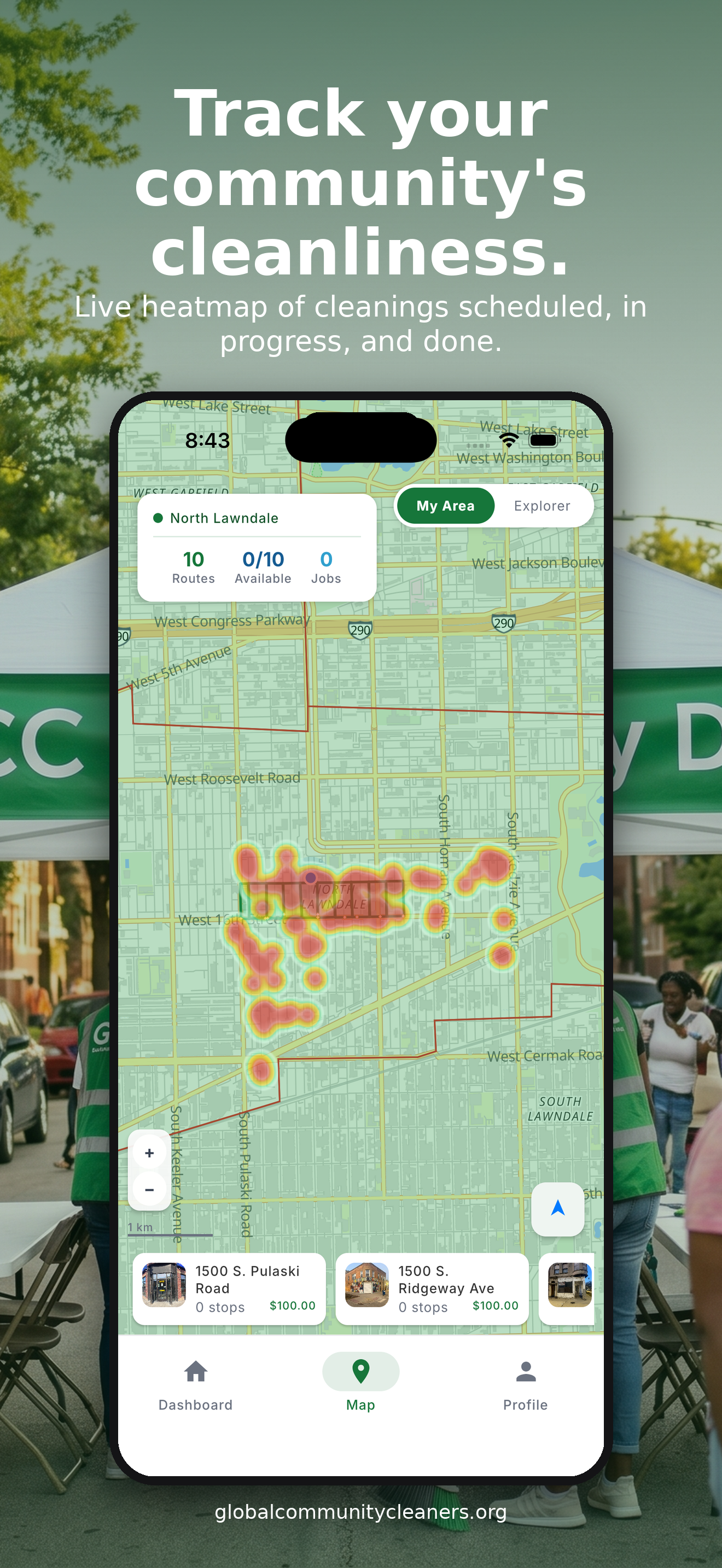
110+ hotspots, every one photographed, GPS-tagged, and timestamped by a resident.
This is not a survey or an estimate. Every red cluster below is a real location someone in the community walked up to, photographed, and logged in the GCC app. The denser the heat, the more accumulation that stretch has seen.
§3 · Four kinds of blight
When you photograph a hundred hotspots, they stop looking random. They sort into types.
Reading the reports back, almost everything residents have logged falls into one of four categories. Naming them matters, because each one has a different long-term fix — and only one of them is actually solved by a broom.
Illegal dumping
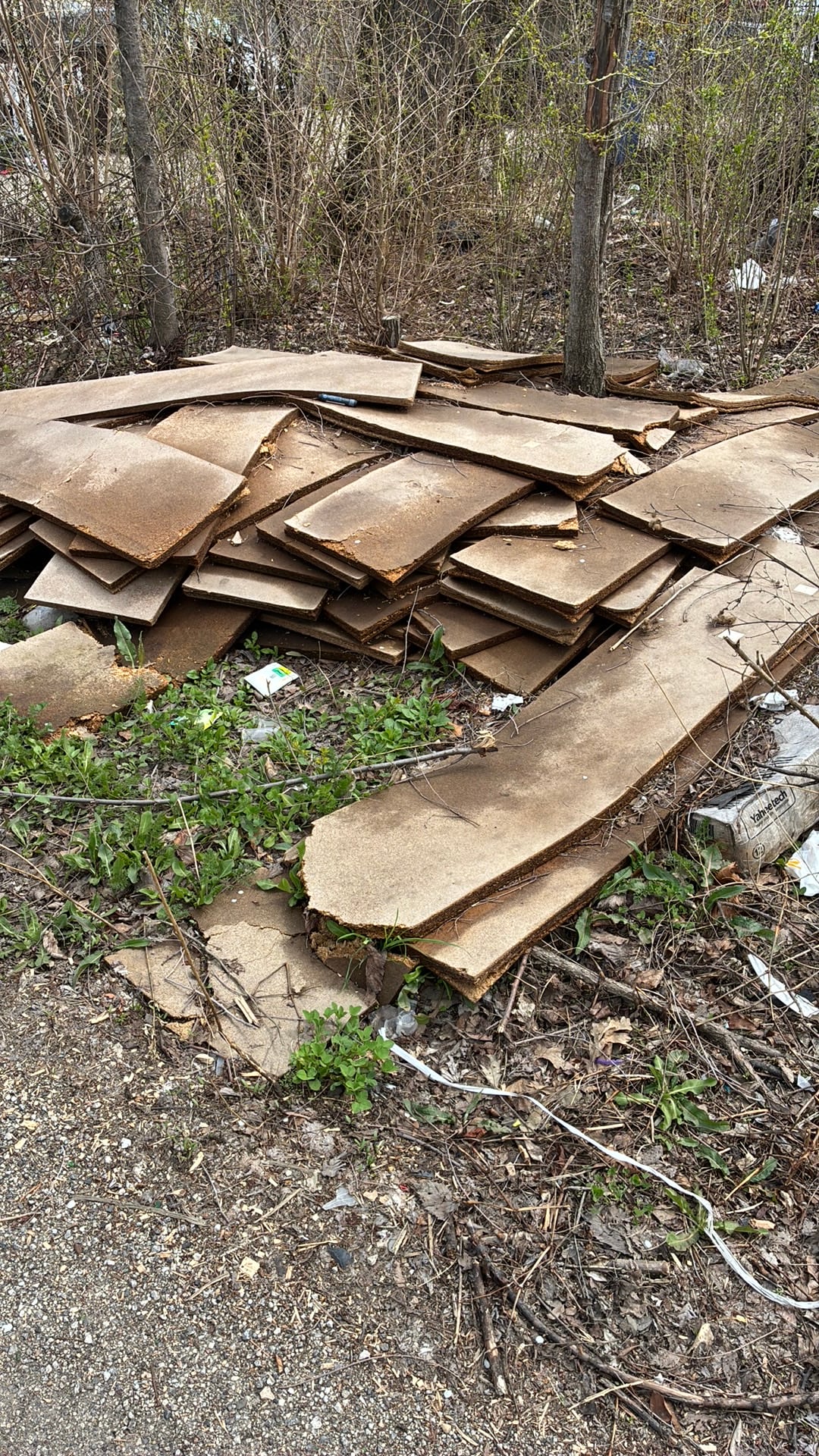
Deliberate drop-offs — cardboard, bagged household trash, mattresses — on residential blocks and parkways, usually overnight. The single most reported type.
Construction & demo debris
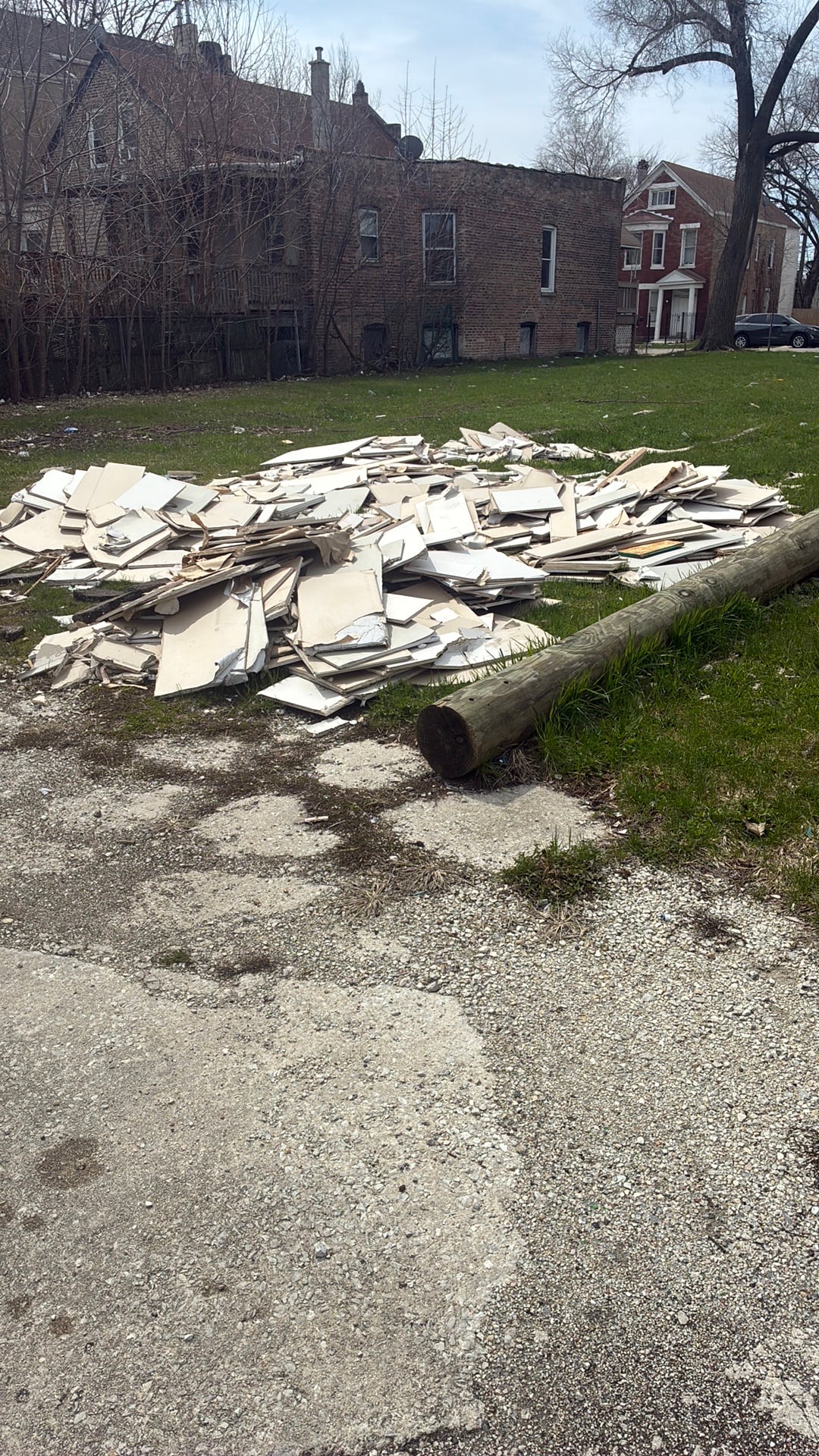
Bricks, drywall, and rubble left on vacant lots and teardown sites. Heavy, slow to clear, and a magnet for more dumping once it sits.
Wind-driven accumulation
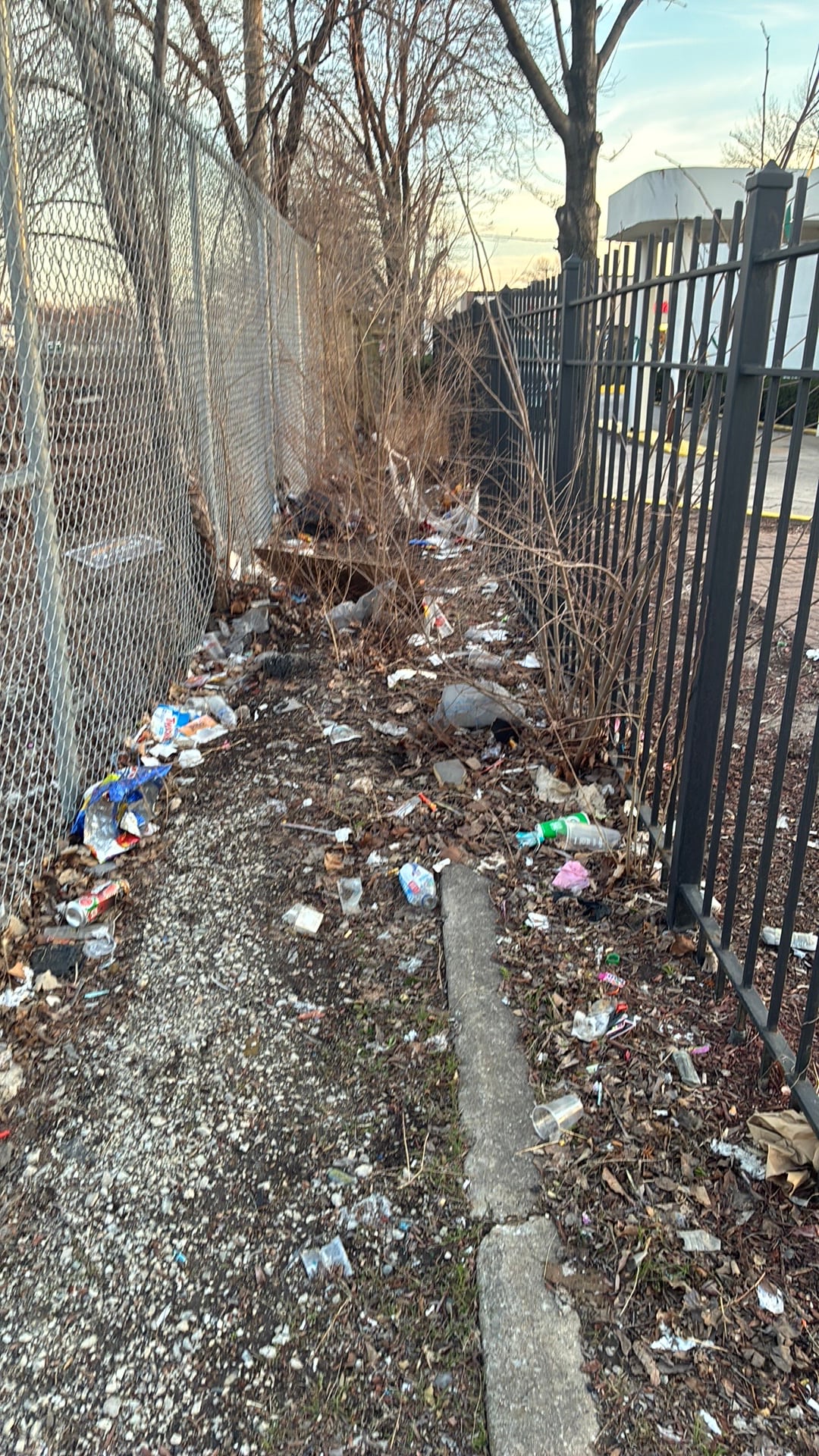
Light litter funneled by wind into fencelines bordering vacant fields and parking lots. Nobody dumped it there — the wind delivered it, and nothing breaks the pattern.
No-receptacle corridors
Pedestrian stretches with no public trash can for blocks at a time. Foot traffic plus nowhere to throw anything equals predictable build-up.
A small sample from the field — three of the 110+ photographs residents have logged, all in or around North Lawndale.
§4 · The corridors we can already name
Two of those four types aren’t cleaning problems at all. They’re infrastructure problems we can point to on a map.
Pattern 1 · Wind-driven fencelines
Fencelines along vacant fields and parking lots catch disproportionate trash — not from dumping, but because wind funnels light debris into them and nothing stops it. Sweep it today, it’s back next windy week.
Long-term fix: simple windbreak plantings or screen fabric on the worst fencelines, plus a cleanup cadence keyed to wind events. A one-time investment, not a forever-loop.
Pattern 2 · Walkway corridors without receptacles
Several major pedestrian corridors run blocks at a time with no public trash can. Hotspot density along them is visibly higher than on comparable stretches that have bins.
Long-term fix: targeted bin placement at high-foot-traffic intersections — a city ask, a property-owner partnership, or a sponsored-bin program. We can name the corridors. We have the data.
This is the real differentiator. We clean the block today, and we identify the infrastructure that would stop the next round before it starts.
§5 · Why the evidence matters
A randomized citywide trial already proved that cleaning blocks changes neighborhoods.
Charles Branas’s team at Penn ran a cluster-randomized trial across Philadelphia — the gold standard — comparing greened lots, trash-removal-only lots, and untouched controls. Published in PNAS and JAMA Network Open, it found a 29% drop in gun assaults around treated lots and large reductions in residents’ reported depression, with the strongest effects for low-income residents.
Robert Sampson’s Chicago research adds the why: neighborhoods high in collective efficacy — whether neighbors feel any agency over their block — run roughly 40% lower crime rates even when income and visible disorder look identical on paper. Our map is collective efficacy made literal: a hundred neighbors deciding their block is worth documenting.
Invest in the people on the block, and the block follows. Our job is to give those people the data, the tools, and the paycheck.
§6 · The tools in our hands came from a neighbor
Our first crews will work with shovels, brooms, and gloves donated by Fields of Dreams Chicago.
On May 13, Fields of Dreams Chicago left GCC’s first in-kind donation ever at the UIC Neighborhood Center: 3 boxes of gloves, 3 shovels, 4 stainless dustpan-and-broom sets, 2 push brooms, and a 30-pack of metal pickup sticks — roughly $500 of the exact equipment our crews need to do the work. Founder James Fields was deliberate about naming it an in-kind gift and even coached us on building the donor records a young nonprofit lives or dies by. That generosity is a gift on top of the gift.
Neighbor spotlight
Fields of Dreams Chicago
Founded in 2024 by James Fields, Fields of Dreams is a North Lawndale youth-empowerment nonprofit serving Black and Latinx young people ages 11–15 through mentorship, wellness, and community service. Its signature Neighborhood Nurturers program runs year-round Saturday sessions at North Lawndale College Prep — a shared meal, team-building, and youth-led service projects — and its summer DreamBuilders Camp centers environmental stewardship. Youth even earn stipends for showing up and leading. They split their members into dream builders (the youth) and vision builders (the mentors), all working toward what they call a beloved community “infused with love and joy.”
In other words: while GCC pays this generation to steward their blocks, Fields of Dreams is raising the next one to do the same. Same neighborhood, same belief — that the people on the block are the ones to care for it.
Visit Fields of Dreams Chicago →The first shovel that breaks ground on a GCC block was handed to us by an organization teaching kids that the block is theirs to love. We couldn’t have scripted a better way to start.
§7 · The points economy — an open invitation
The map gets stronger every time someone contributes. We want to make contributing worth it.
The GCC app is global. Anyone, anywhere, can spot illegal dumping or blight in their neighborhood, photograph it, and add it to the map — and other users earn points by verifying a spot is real, still there, or resolved. The data layer compounds with every contribution.
We’re building this into a points system worth participating in, and we’re lining up local businesses to back the points with rewards our community actually wants:
Reward types in development
🏟️ Sports & concert tickets · 🎁 Gift cards from neighborhood businesses · 🍽️ Restaurant credits · 🛍️ Discounts from partner retailers · 💎 Redeemable points across our internal network
Chicago businesses, this is your invitation
If you can put real value behind these points — tickets, gift cards, table reservations, in-store credits — we’ll put your brand directly in front of the residents already cleaning their own streets.
It’s the cleanest community-affairs ROI in the city: documented impact, photographable proof, and an audience that lives right where you sell. Fields of Dreams Chicago showed what one intentional neighbor can do with a $500 gift. Imagine what your brand could do. Email hello@globalcommunitycleaners.org with the subject line “Partner on points”.
§8 · The ask
Equipment is in hand. Now we need the blocks funded.
Thanks to Fields of Dreams, our first crews are equipped. A $100 block sponsorship puts that equipment in a resident’s hands, pays them for the work, and sends a before-and-after photo set to your inbox. 100% of the block fee goes to the person doing the work.
$100 = one cleanup, one paid resident, one before-and-after photo set in your inbox.
$2,000 = your name on our public wall, a digital certificate, a 501(c)(3) tax receipt, a feature in this newsletter, and social-media recognition.
§9 · What's next
We’re closing the funding to put those first crews on the street.
Our goal for the North Lawndale pilot hasn’t changed: 100 blocks cleaned, 100 community members paid on their own streets. The equipment is here. The map is mapped. What stands between today and the first before-and-after report is funded blocks — and every $100 sponsorship moves one resident from the waitlist to the work.
Goal · North Lawndale pilot
100 blocks cleaned · 100 community members paid
First cleanups: equipped and in preparation. Sponsor a block to put one on a resident’s street.
When those blocks are funded and cleaned, the next issue is the one we’ve been promising: the first block-by-block before-and-after report, with the residents who claimed them — names, photos, blocks.
Dr. King’s apartment is six blocks away. The work continues.
— The team at Global Community Cleaners NFP
Sponsor a block → · Read Issue #1 · GCC home
Global Community Cleaners NFP · 1844 S. Harding Ave, 2nd Floor · Chicago, IL 60623 · 501(c)(3) tax-exempt · EIN 39-3553882