GCC Blog · Issue #1 · The Founder's Letter
May 1, 2026
Sixty years and two blocks
Three things: where we come from, what we already know about our neighborhood, and what we're going to do about it.
§1 · The history
On January 26, 1966, Dr. Martin Luther King Jr. carried his bags up to a third-floor walk-up at 1550 South Hamlin Avenue in North Lawndale and started what he called the “action phase” of the Chicago Freedom Movement — the campaign that brought him here to focus on housing conditions and economic opportunity in Chicago neighborhoods. The campaign produced the Summit Agreement, which fed directly into the 1968 Fair Housing Act.
Today, Global Community Cleaners is headquartered at 1844 South Harding, 2nd Floor, a six-block walk from the apartment Dr. King moved into.
Sixty years. Two blocks of distance. Same neighborhood, same work.
§2 · The data we already hold
We're not a cleaning service. We're the field-evidence layer for community cleanliness in North Lawndale.
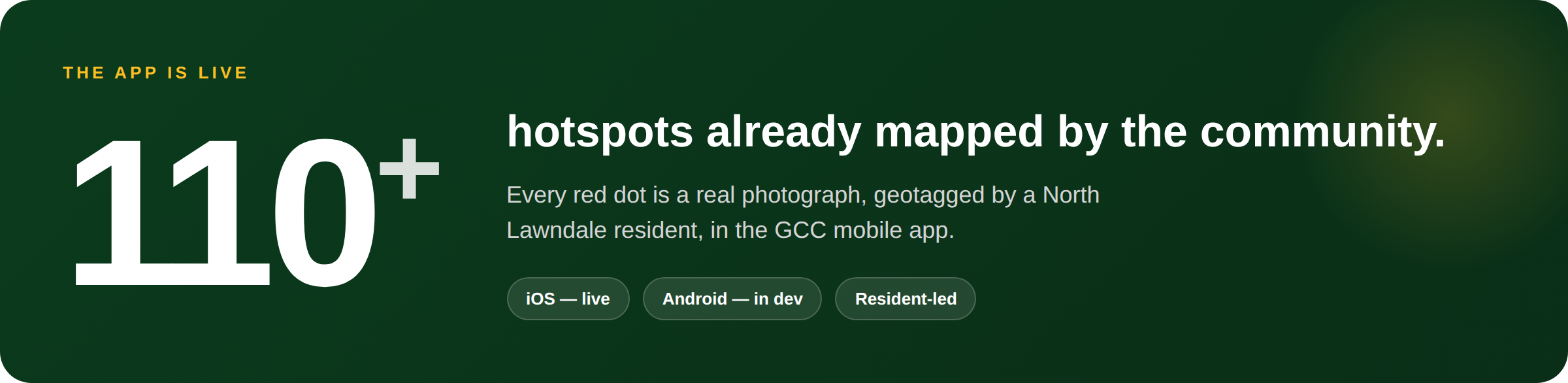
Most organizations talk about a problem. We hold the data on it. The GCC mobile app is live on iOS (Android version in development), and North Lawndale residents have already used it to map — with photos, GPS, and timestamps — 110+ trash and dumping hotspots across the community.
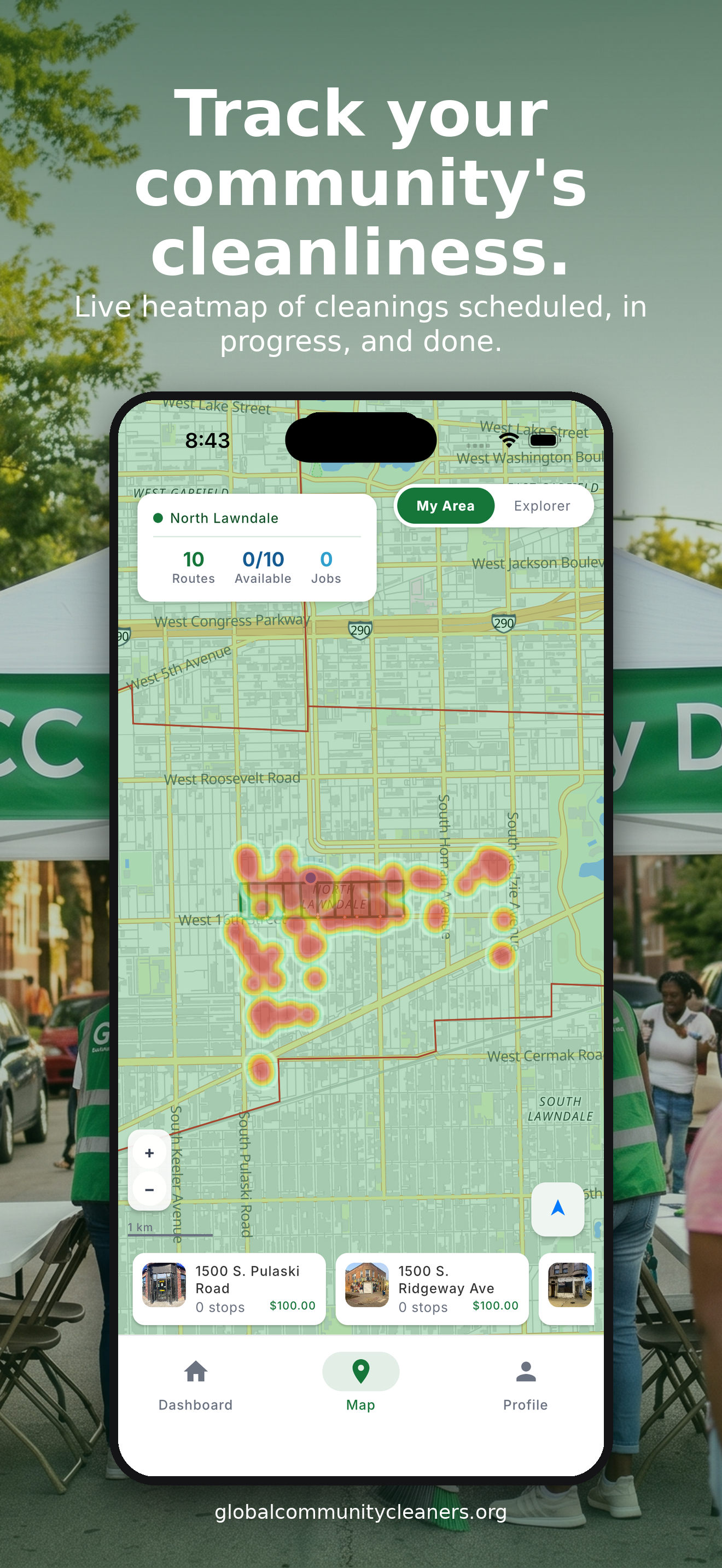
Live heatmap · GCC mobile app
Every red cluster below is a real, photographed hotspot a resident reported. The denser the heat, the more accumulation that block has seen.
§3 · What 110 hotspots actually look like
We documented it because reading it doesn't do it justice.
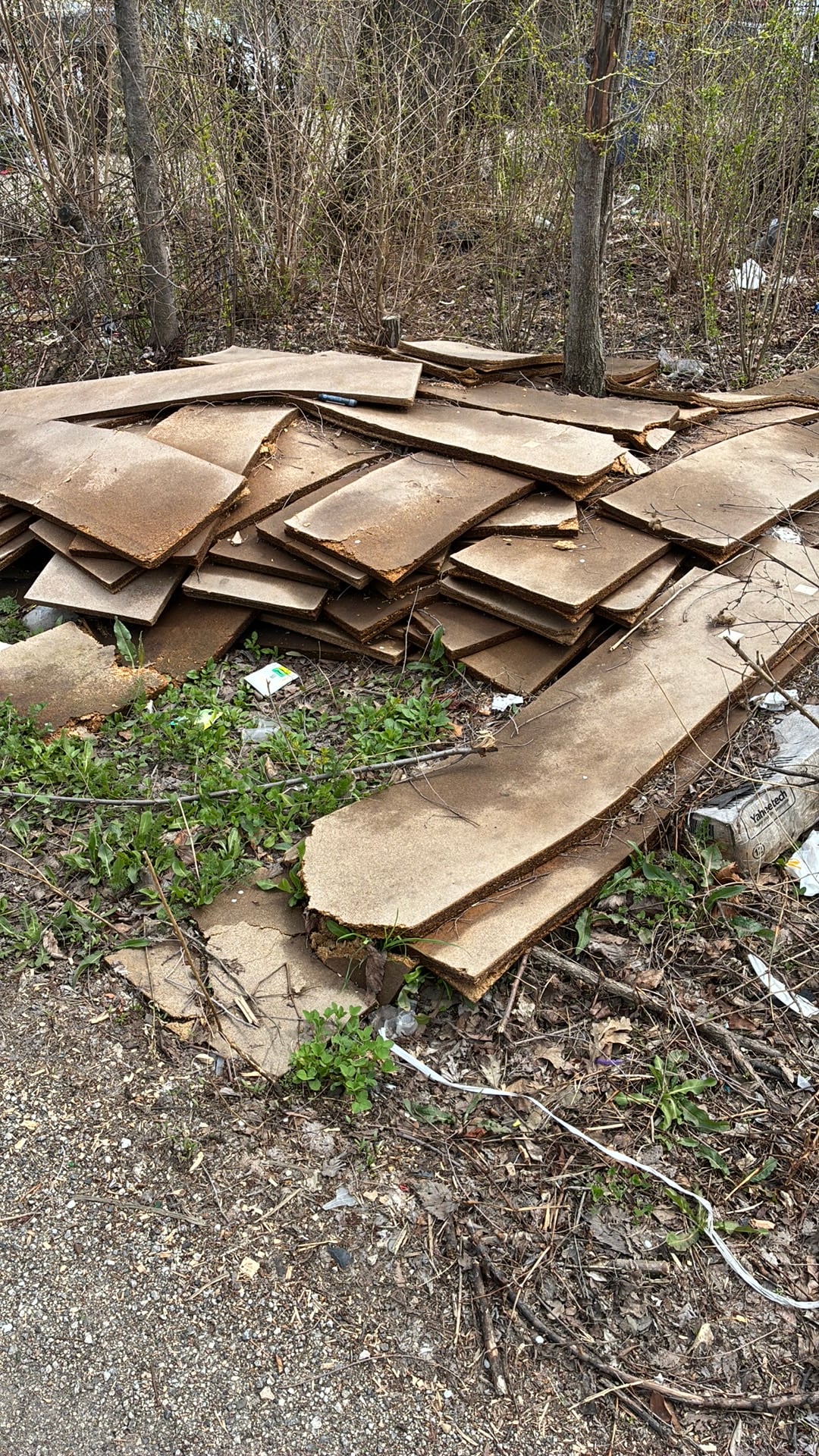
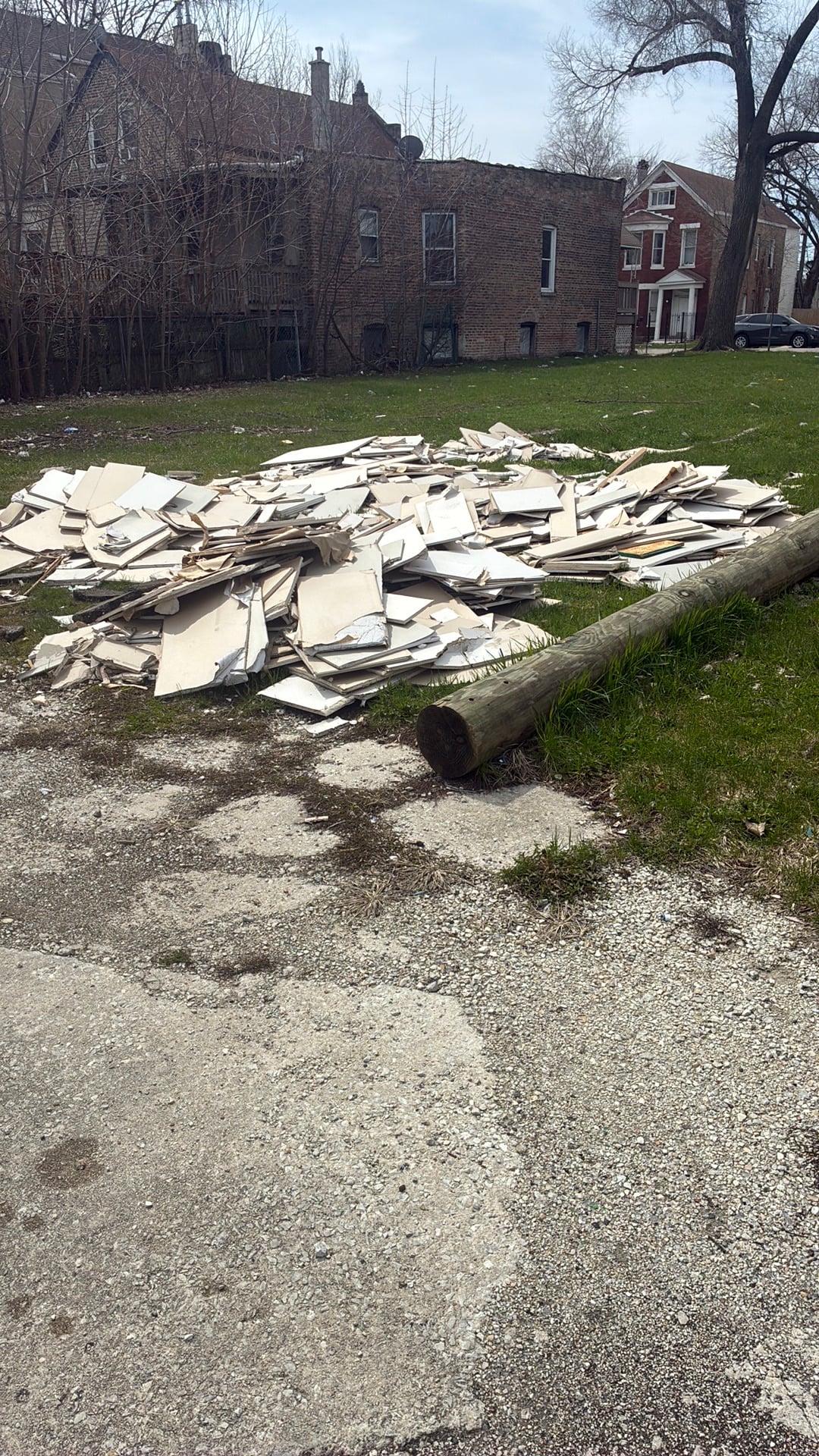
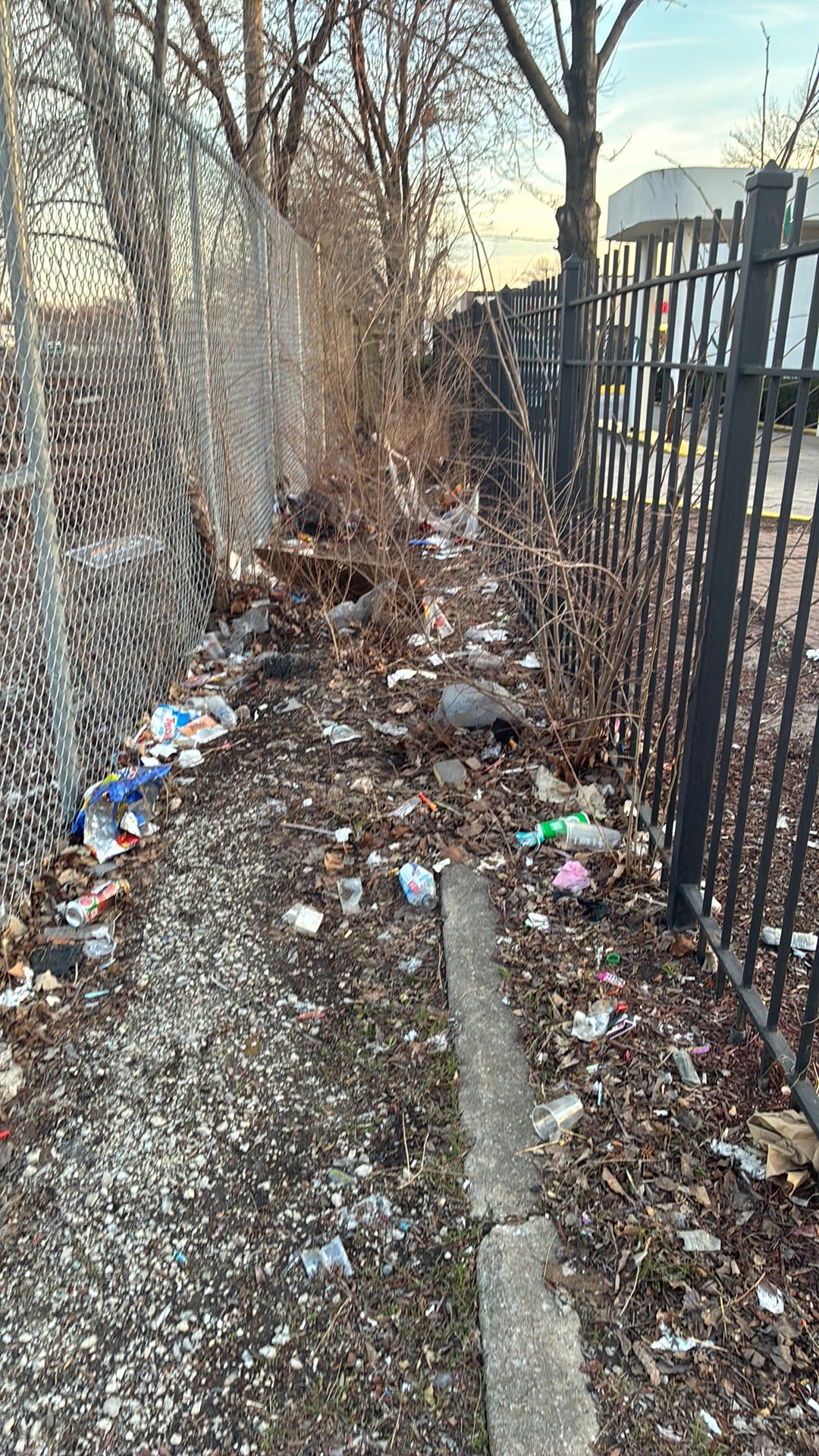
A small sample from the field. Three of the 110+ photographs residents have logged in the app — all in or immediately around North Lawndale, all captured in the last several weeks.
§4 · Patterns the data reveals
110 photographs add up to a small body of urban evidence. Two patterns jumped out.
Pattern 1 · Wind-driven fenceline accumulation
Fencelines bordering vacant fields and parking lots are catching disproportionate trash — not because residents dump there, but because wind funnels light debris into them and nothing breaks the pattern.
Long-term fix: simple windbreak plantings or screen fabric along the worst fencelines, plus a cleanup cadence keyed to wind events. Recoverable infrastructure investment, not a cleanup forever-loop.
Pattern 2 · Walkway corridors without trash receptacles
Several major pedestrian corridors in North Lawndale have no public trash cans for blocks at a time. Hotspot density along these corridors is measurably higher than in zones with built-in receptacles.
Long-term fix: targeted bin placement at high-foot-traffic intersections — either a city ask, a property-owner partnership, or a sponsored bin program. We can name the corridors. We have the data.
This is the real differentiator. We clean the blocks, and we identify what infrastructure could stop the next round of accumulation before it starts.
§5 · Why this works
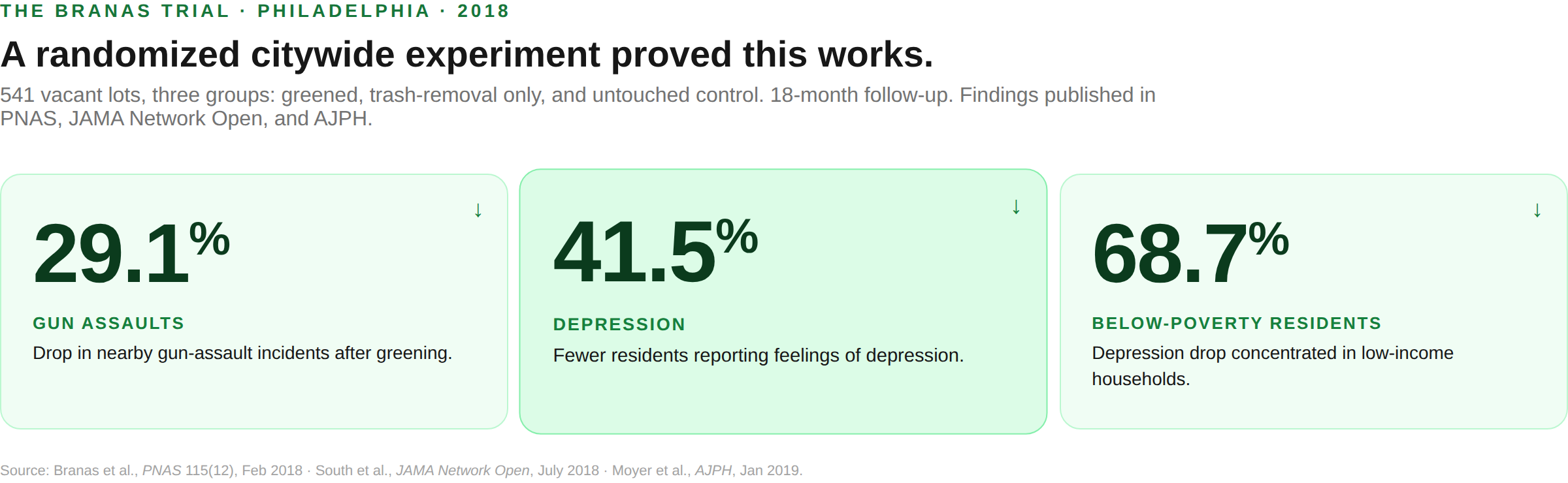
A randomized citywide trial — the gold standard — proved this model works.
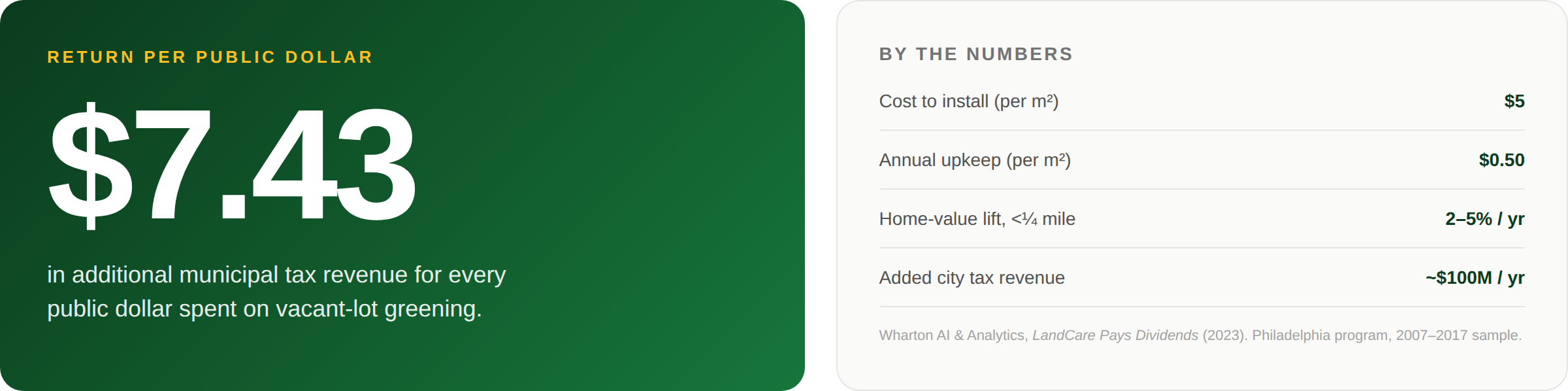
Charles Branas's team at Penn ran a cluster-randomized trial across Philadelphia, comparing greened lots, trash-removal-only lots, and untouched controls over 18 months. The results, published in PNAS and JAMA Network Open, are some of the strongest evidence in the urban-policy literature for any intervention at any cost.
The newer research goes further. A 2019 meta-analysis in Social Science & Medicine found that the original broken-windows hypothesis works mostly as a downstream signal of collective efficacy — whether neighbors feel any agency over their block. Robert Sampson's Chicago research showed that neighborhoods scoring high on collective efficacy run roughly 40% lower crime rates, even when income, race, and visible disorder look similar on paper.
The lesson, repeated across every modern study: invest in the people on the block, and the block follows.
§6 · The neighborhood we're working in
The municipal data on North Lawndale isn't subtle.
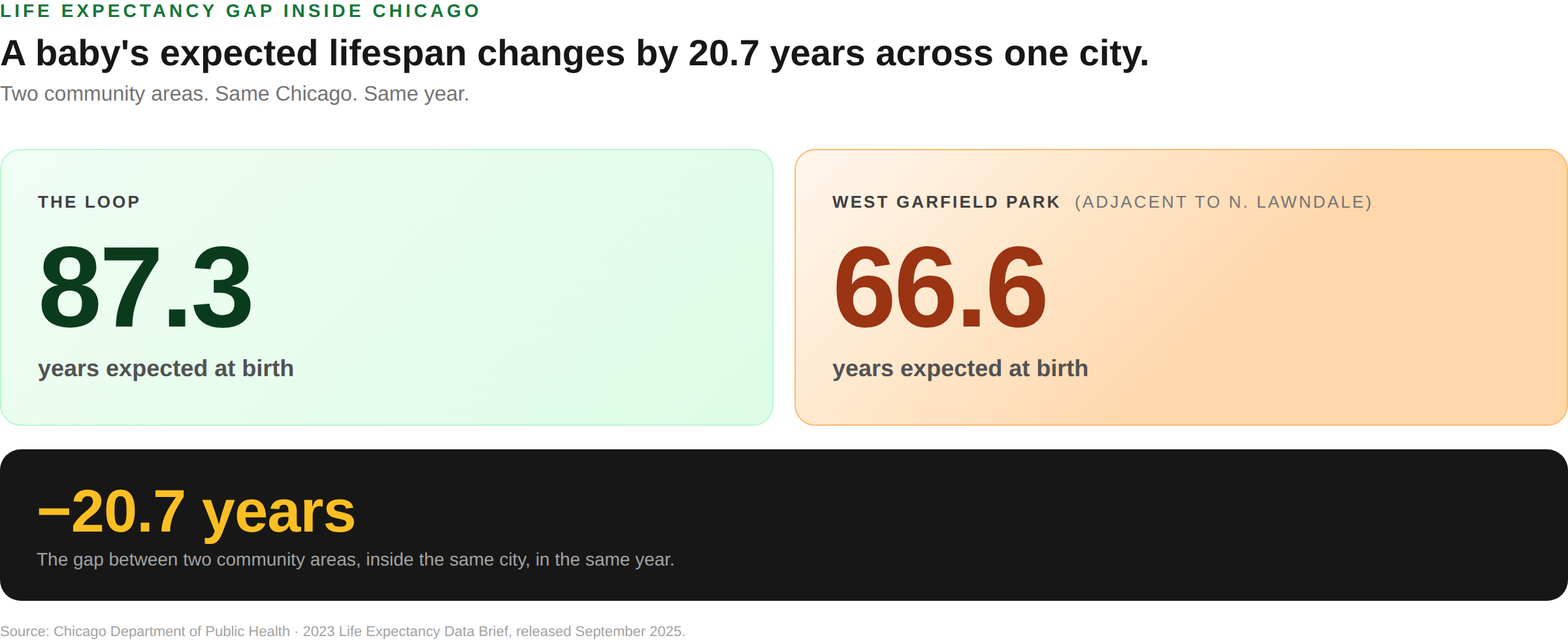
Black Chicagoans died 10.6 years earlier than non-Black Chicagoans in 2023 (CDPH). North Lawndale's per-capita violent-crime rate runs roughly 3× the citywide rate; it sits on the city's official list of areas “most affected by violence” (UIC Great Cities Institute, 2022). This is the gap a $100 block fee, paid to the resident on the block, is built to start closing.
§7 · Meet the founder
Shaquille Tate built it because he was tired of seeing it.
Born at Mt. Sinai Hospital in North Lawndale. Raised on the blocks running from 15th Street to Ridgeway. Drives Divvy across the entire city for his day job — which means he sees what every Chicago neighborhood looks like from the curb. Asked on a 2026 radio interview how the idea found him, he answered:
“I had to come back to the North Lawndale community, and I'm walking past abandoned houses — boards on the windows, broken windows, trash everywhere on the floor.”
“What if somebody could get all these kids to clean up their block? And if they were to clean up their block, to get paid to clean up their block.”
“I'm employing elders and I'm employing youth and I'm paying them a hundred dollars to clean up their blocks. I want to start with a 10-block radius… This is more than just picking up trash.”
He's right. It is about cleaning, but it's also about cash, dignity, ownership, and the simple fact that the people best equipped to take care of a block are the people who live on it — if someone is willing to pay them like the work matters. Because it does.
§8 · How the model works
Plain on purpose.
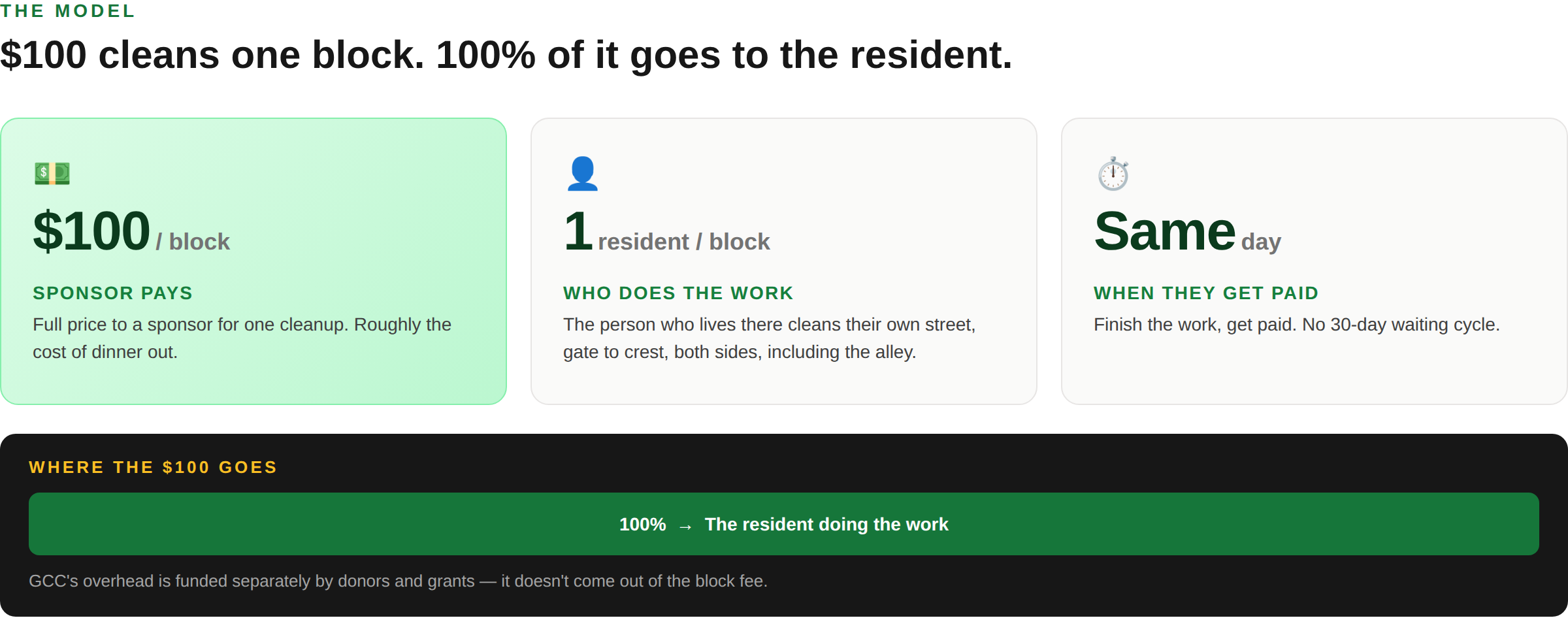
One participant per block. Elders and youth — the model is intergenerational by design. Before-and-after photos to every sponsor; block status logged in our system. The same measurement discipline that turned greening from a hunch into peer-reviewed practice.
A $100 block sponsorship gets your name on our public sponsor wall. A $2,000+ sponsorship unlocks the recognition tier — name on the wall, digital certificate of appreciation, 501(c)(3) tax receipt, monthly newsletter feature, and social-media recognition across our channels.
§9 · Anyone, anywhere can participate
You don't have to live in Chicago to put a hotspot on the map.
The GCC app is global. Any user, anywhere in the world, can spot illegal dumping, blight, or unsafe conditions in their own neighborhood, photograph it, and add it to the map. Other users earn points by verifying a spot is real, still there, or has been resolved. The data layer compounds with every contribution.
We're building this into a points system worth participating in. We are actively working with local businesses to back the points with rewards our community actually wants:
Reward types in development
🏟️ Sports & concert tickets · 🎁 Gift cards from neighborhood businesses · 🍽️ Restaurant credits · 🛍️ Discounts from partner retailers · 💎 Redeemable points across our internal network
Local businesses, this is your invitation
If you can put real value behind these points — tickets, gift cards, table reservations, in-store credits — we will put your brand directly in front of the residents already cleaning their own streets.
It's the cleanest community-affairs ROI in Chicago: documented impact, photographable proof, audience that lives right where you sell. Email hello@globalcommunitycleaners.org with the subject line "Partner on points".
§10 · The ask
If this resonates, here is exactly what to do with that.
$100 = one cleanup, one paid resident, one before-and-after photo set in your inbox.
$2,000 = your name on our public wall, a digital certificate, a 501(c)(3) tax receipt, a feature in this newsletter, and social-media recognition.
§11 · What's next
Right now we're lining up the first 20 cleanups.
Twenty blocks — twenty paid residents — 20% of our way to the 100-block goal we set for the North Lawndale pilot. One hundred blocks cleaned, one hundred community members earning real money on their own street. That's the floor, not the ceiling.
The first 20 are pending a soft commitment we're closing with a local partner; we'll name them in the next issue once the funding has cleared and the work is underway. In the meantime, every $100 block sponsorship we receive between now and then funds an additional cleanup on top of those 20.
Goal · North Lawndale pilot
100 blocks cleaned · 100 community members paid
First 20 cleanups: in preparation. Sponsor a block to put it on a resident's street.
In June we publish the first block-by-block before-and-after report. In July we feature the residents who claimed those first cleanups: names, photos, blocks.
In the meantime — Dr. King's apartment is six blocks away. The work continues.
— The team at Global Community Cleaners NFP
Global Community Cleaners NFP · 1844 S. Harding Ave, 2nd Floor · Chicago, IL 60623 · 501(c)(3) tax-exempt · EIN 39-3553882