About Global Community Cleaners
Why we do what we do
Our origins in North Lawndale, why we’re not a cleaning service, and the people behind the work.
Our origin
On January 26, 1966, Dr. Martin Luther King Jr. carried his bags up to a third-floor walk-up at 1550 South Hamlin Avenue in North Lawndale and started what he called the “action phase” of the Chicago Freedom Movement — the campaign that brought him here to focus on housing conditions and economic opportunity in Chicago neighborhoods. The campaign produced the Summit Agreement, which fed directly into the 1968 Fair Housing Act.
Today, Global Community Cleaners is headquartered at 1844 South Harding, 2nd Floor, a six-block walk from the apartment Dr. King moved into.
Sixty years. Two blocks of distance. Same neighborhood, same work.
Why we exist
We’re not a cleaning service. We’re the field-evidence layer for community cleanliness.
Most organizations talk about a problem. We hold the data on it. Our positioning rests on three pillars:
Historical legitimacy
Rooted six blocks from where Dr. King launched the Chicago Freedom Movement's action phase in this exact neighborhood.
Academic data
Grounded in peer-reviewed evidence — the Branas Philadelphia trial, Sampson's collective-efficacy research — not intuition.
Civic-cleanliness data
Every hotspot residents log is photographed, GPS-tagged, and timestamped — a real, growing dataset on the ground.
We pay the resident on the block to clean it, and we document every inch of it. That documentation — not the cleaning alone — is what makes GCC data infrastructure for community cleanliness, not a cleaning service.
Meet the founder
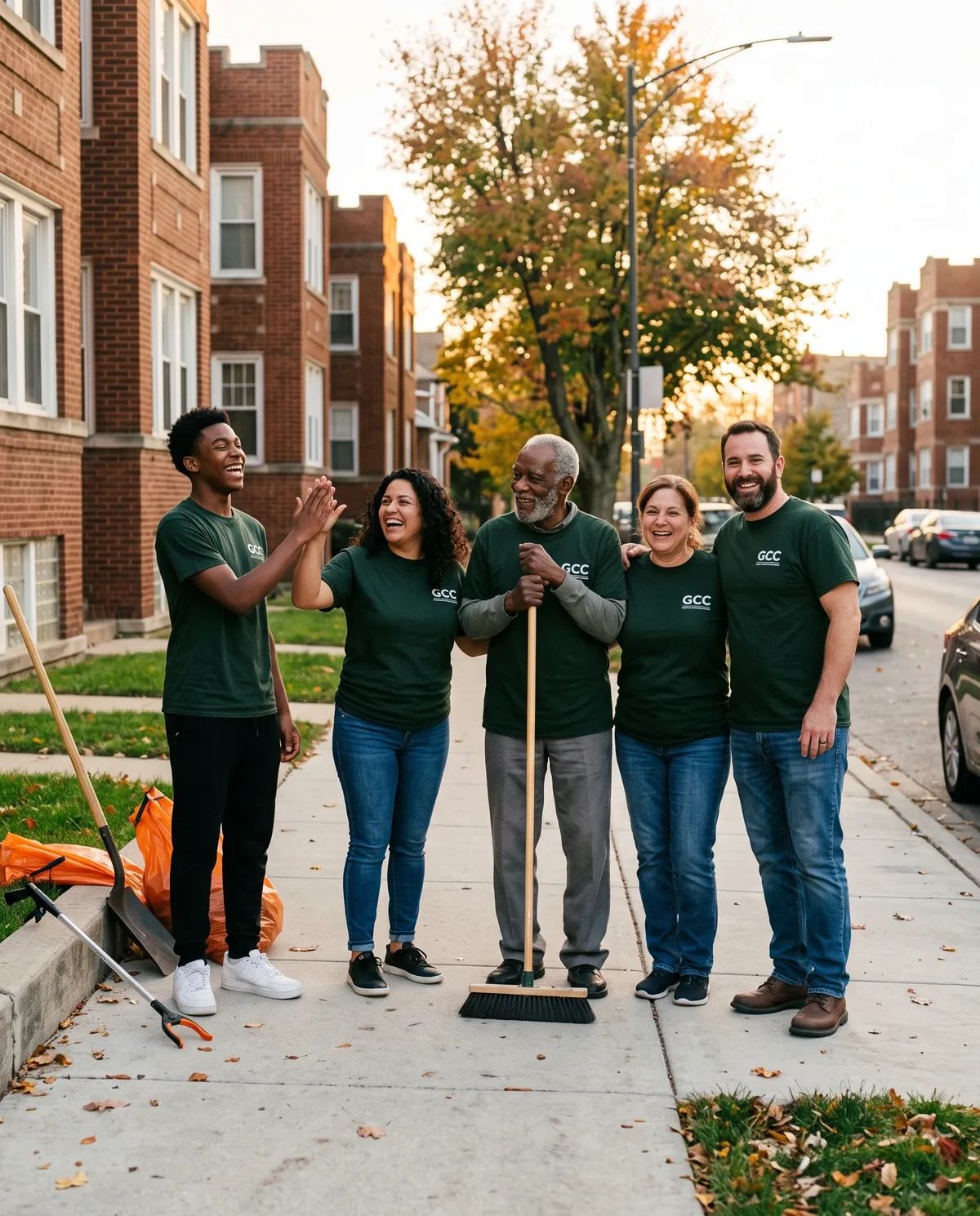
Shaquille Tate built it because he was tired of seeing it.
Born at Mt. Sinai Hospital in North Lawndale. Raised on the blocks running from 15th Street to Ridgeway. Drives Divvy across the entire city for his day job — which means he sees what every Chicago neighborhood looks like from the curb. Asked on a 2026 radio interview how the idea found him, he answered:
“I had to come back to the North Lawndale community, and I’m walking past abandoned houses — boards on the windows, broken windows, trash everywhere on the floor.”
“What if somebody could get all these kids to clean up their block? And if they were to clean up their block, to get paid to clean up their block.”
It’s about cleaning, but it’s also about cash, dignity, ownership, and the simple fact that the people best equipped to take care of a block are the people who live on it — if someone is willing to pay them like the work matters. Because it does.
The evidence base
This model isn’t a hunch. It’s backed by the research.
Charles Branas’s team at Penn ran a cluster-randomized trial across Philadelphia — the gold standard — comparing greened lots, trash-removal-only lots, and untouched controls. Published in PNAS and JAMA Network Open, it found a 29% drop in gun assaults around treated lots, with the strongest effects for low-income residents.
Published in PNAS and JAMA Network Open. Bars show percent reduction in treated lots relative to untouched controls over the 18-month trial.
Robert Sampson’s Chicago research adds the why: neighborhoods high in collective efficacy — whether neighbors feel any agency over their block — run roughly 40% lower crime rates even when income and visible disorder look identical on paper.
−40%
Crime rate in neighborhoods that score high on collective efficacy — whether neighbors feel any agency over their block — compared to similar-income, similar-disorder neighborhoods that score low. — Robert Sampson, Chicago research
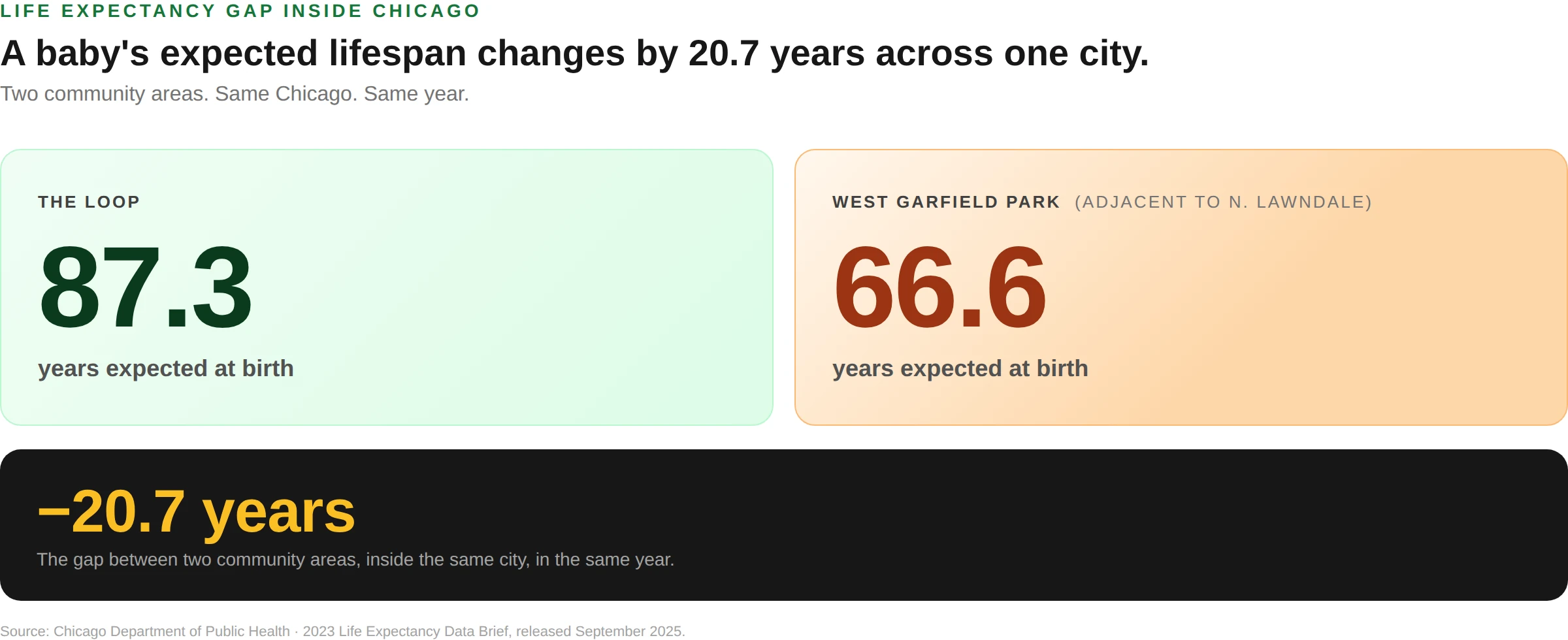
The stakes locally aren’t abstract. A baby born in The Loop today can expect to live 20.7 years longer than one born in West Garfield Park, immediately adjacent to North Lawndale — same city, same year.
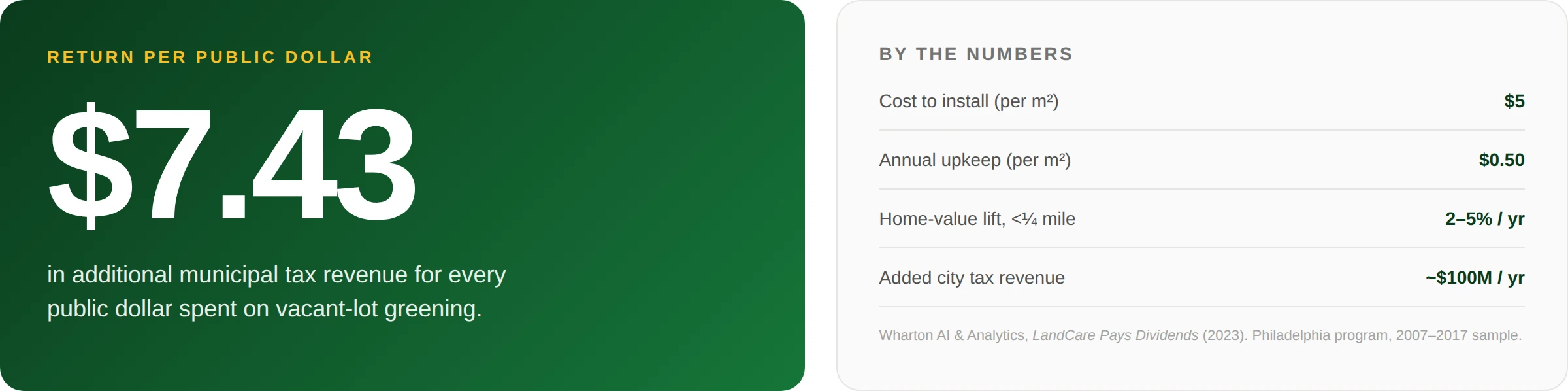
And greening isn’t just a cost — a Wharton analysis of Philadelphia’s program found it pays for itself several times over.
Invest in the people on the block, and the block follows. Our job is to give those people the data, the tools, and the paycheck.
Get involved
If this resonates, here’s exactly what to do with that.
Global Community Cleaners NFP · 1844 S. Harding Ave, 2nd Floor · Chicago, IL 60623 · 501(c)(3) tax-exempt · EIN 39-3553882